Curriculum
CIPS Level 4 Module 5 (Commercial Negotiation 6Cr)
Commercial Negotiation (L4M5)
0/19
-
L4M5 Commercial Negotiation Module Overview
 Preview
 -
LO 1.0 Understand key approaches in the negotiation of commercial agreements with external organisationsSorry, this lesson is currently locked. You need to complete "L4M5 Commercial Negotiation Module Overview" before accessing it.
Preview
-
1.1 Practice questions

-
1.2 Practice questions
-
1.3 Practice questions
-
1.4 Practice questions
-
1.0 Case study
-
LO 2.0: Know how to prepare for negotiations with external organisations
-
2.1 Practice questions
-
2.2 Practice questions
-
2.3 Practice questions
-
2.4 Practice Questions
-
2.0 Case study
-
LO 3.0: Understand how commercial negotiations should be undertaken
Preview
-
3.1 Practice questions
-
3.2 Practice questions
-
3.3 Practice questions
-
LO 3.4 Practice Questions
-
L4M5 EXAM PRACTICE QUESTIONS

LO 3.0: Understand how commercial negotiations should be undertaken
3.1 Identify the stages of a commercial negotiation
• The meeting stage is where listening and question skills are put to the test and where careful exchange of information and interpretation of signals will be rewarded with a good deal
• Preparation is key to any negotiation to provide:
o Confidence
o Direction
o Reduces exploitation by the other party
o Negotiation preparation checklist
3.1 Defining the stages of a negotiation
❏ Stages of a negotiation such as: – preparation, opening, testing, proposing, bargaining, agreement and closure:
• Negotiation meetings differ enormously in terms of subject matter, time to prepare, time available and people involved
• There are sequential stages in a typical negotiation (RESPECT, Hills)
o Step 1: Ready yourself (preparation)
o Step 2: Explore needs
o Step 3: Signal for movement
o Step 4: Probe with proposals
o Step 5: Exchange concessions
o Step 6: Close the deal
o Step 7: Tie up the loose ends
• A general assumption that the principled approach (win-win) is the best starting point, but not always
3.1 Stages of a negotiation
 Figure 3.1 The key stages of negotiation
3.1 Opening stage
❏ Opening stage
• This stage is the first few minutes when the parties meet and greet each other and are seated in the negotiation room in preparation for the main event.
• It sets the tone for the meeting.
• Be on time, get the names of the other party right and offer a firm handshake, maintaining eye contact. Speak clearly and be courteous. Be prepared to engage in small talk to break the ice.
• Check the people in the room have the authority to make a deal.
• By the end of this stage, you should check that you have got all the issues you want to discuss on the table.
3.1 Testing stage
❏ Testing stage
• Each side ‘tests’ the other’s position without giving away too much about its own.
• The information gained at this stage may help you decide which negotiating option to go for, or to change your approach – either tougher or less demanding.
• Listen attentively, use open questions to obtain missing information, identify common ground, clarify both parties’ perceptions to avoid misinterpretations, and show concern for the other party’s needs and interests.
• Develop new options (in your head or on paper) based on any new or unexpected information to share with your team during a breakout session.
• At the end of the testing phase you should have confirmed or clarified your key assumptions and should understand the ‘why and what’ of the negotiation so that there is less risk of surprises later.
3.1 Proposing stage & Bargaining stage
❏ Proposing stage
• Both sides will be seeking to establish if a zone of potential agreement (ZOPA) exists.
• Either side may start making tentative proposals regarding their offering.
• In the case of a negotiation where the other party has already submitted a tender or proposal, this stage may provide an opportunity for them to make proposals to improve on their initial offers.
● These could be general suggestions or could target areas highlighted in advance by the buying side.
❏ Bargaining stage
• Both parties trade concessions.
• Proposals move from being tentative and general to being more definite and specific.
• This stage may be short, particularly if the testing and proposing stages have elicited useful insights by both parties into each other’s underlying interests, red lines and walk-away points, and the ZOPA is effectively confirmed.
3.1 Agreement and closing phase
❏ Agreement and closing phase
• Not all negotiations will get to this stage.
• Judging when to close can be difficult.
● Listen for explicit language and look for non verbal cues.
• Make sure that all issues have been resolved and there is no ambiguity about any of the terms. Summarise to confirm what has been agreed to lead to final agreement.
• You can seek agreement in principle if the other party does not have the final authority.
• Shake hands on the agreement and leave the meeting as soon as possible thereafter.
• Immediately or as soon as possible after the negotiation, put the terms or details of the agreement in writing if you have not already got them, to confirm mutual understanding.
3.2 Key methods that can influence the achievement of desired outcomes:
❏ The use of persuasion methods:
• Persuasion and influence defined o Persuasion
o Influence
• Choosing between push and pull
o Directive (push)
o Collaborative (pull)
o Persuasive reasoning (push)
o Visionary (pull)
• Irritators
3.2 Persuasion methods
❏ Persuasion means ‘pushing’ on the other party so that they accept their own change in attitude or behaviour as a result of your actions.
❏ Influence means ‘pulling’ on the other party, which gets them to change their attitude or behaviour as a result of reflection.
❏ Professor Fiona Dent broke down push and pull into two types.
• Push can be ‘directive’ or ‘reasoning’
• Pull can be ‘collaborative’ or ‘visionary’
❏ Various factors determine when each one is most appropriate to use
• Directive is an ‘I’-driven push style where the influencer asserts their own views and ideas and expects others to follow. Use this if you are an expert, are working ith new or inexperienced staff, and you require speedy action.
• Persuasive is an issue-driven push style where the influencer wants others to buy into their ideas by presenting them in an even-handed, logical, rational and objective way. Use this if your credibility and knowledge are high, you need to get buy-in to an unpopular decision and you have done research that shows this is the best answer.
• Collaborative is a team-oriented pull style where the influencer aims to involve others who will offer views and ideas about the issue. Use this when you need commitment from others, and you want innovative ideas from others because the ssue has no clear answer.
• Visionary is a pull style where you have to tap into others’ emotions, engage their imagination and help them visualise what is possible. Use this when you are at the beginning of a complex change process, you need to get people’s attention and innovative thinking is required.
3.2 Tactics for influencing in a negotiation
❏ Tactics are actions or strategies carefully planned to achieve a specific end.
• They work best if used sparingly and as part of your plan.
• They are particularly effective when dealing with untrained negotiators.
• Their effectiveness will decrease over time, as the other party will recognise and be able to counter them if you use them repeatedly.
3.2 Negotiation tactics
• Good cop/bad cop – put on an act to make the other party warm to the good cop and make more concessions than they would in absence of the bad cop.
• Thank and bank – say thank you when the other party offers you a concession and ‘bank’ it, making it harder for the other party to take it back later.
• Lack of authority, ‘board approval’ – extract another concession that allows you to sign off there and then; say that if, for example, the price is less than $1m, you do not have to get board approval.
• Declaration of a public stance – say publicly what you expect from a deal, e.g., promise union members a 10% pay rise. Use this as emotional pressure with the employer in the meeting to gain concessions without which you would lose face,
which in many cultures is highly undesirable.
• Getting peanuts – pretend something that you need is not important. For example, you might not initially communicate your need for urgency in case the other party wants to supply ASAP. This means that you may not need to pay extra, whereas if
you indicate the value of fast delivery you will be charged for it. Always trade concessions.
• Salami (one slice at time) – ask for an exceptional one-off concession that is normally hard to get, e.g., an extra-long payment period. Once granted, the precedent is set and it will be easier to get again.
• Outrageous initial demand – your first demand is so high that the other party is shocked and you condition them to move closer to your position. This is linked to anchoring.
• Add on – unexpected extras are added on after the negotiation that were not clarified or explicitly discussed, e.g., out-of-hours support costs, hidden fees, or discounts dependent on extra-prompt payment.
• Broken record – keep repeating something, e.g., repeatedly emphasise the budgetary pressures you are under to condition the other party into thinking you have no money.
• One more thing – wait until the end to ask for a concession you know is contentious. You still may not get it but as the deal is so close the other party may be more likely to concede at this stage when reopening the negotiation is not attractive.
3.3 Key communication skills to achieve desired outcomes
• Good negotiators are aware of the different types of questions that they can ask in order to get an answer
• There are multiple ways of asking the same question if the other party is unwilling or reluctant to answer
• In many negotiations, the side with the most information and insight is at an advantage and intelligent questioning is the best way to elicit information at all stages
3.3 Types of questions
• Reasons for asking questions in negotiation
o To condition the other party
o To suggest you are naïve or unaware of something (tactical advantage)
o To create an impression of knowledge
o To test honesty of the other party
o To create and sustain movement in a negotiation
3.3 Question styles
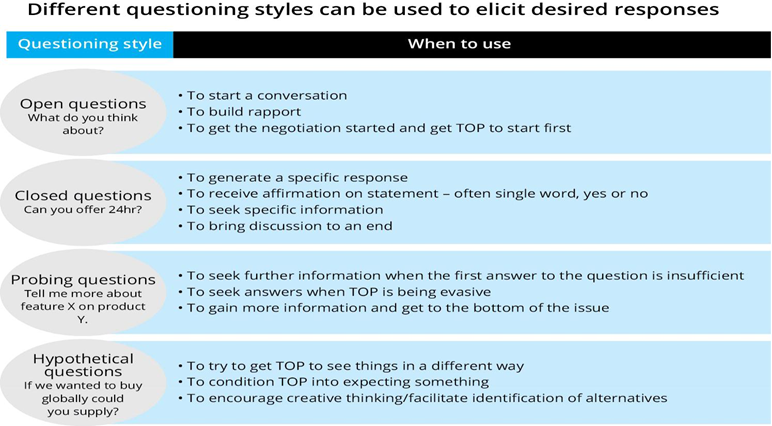
Figure 3.2 Questioning styles
3.3 Active listening
❏ Skilled negotiators have good listening skills.
• They use active listening to provide them with more information.
• They are attuned to verbal communication signals from the other party – they note how other negotiators use word choice and sentence structure for effect.
• They are attuned to nonverbal communication signals from the other party – they note vocal features such as pitch, tonal quality and rate of speech.
❏ Three common pitfalls that hinder active listening are as follows.
• Thinking of negotiation as a job of persuasion, and speaking rather than listening
• Using the time in which the other person is talking to prepare what to say next
• Not hearing what you do not want to hear
❏ The following rules of active listening will help you to become a successful negotiator.
• Be motivated to listen.
• Do not interrupt the other party when they are speaking.
• Fight distractions.
• Write everything down.
• Listen with a goal in mind.
• Give the other party your undivided attention.
• React to the message, not the person.
3.3 How to improve your active listening
❏ To improve your active listening skills, practise some of the following techniques.
• Ask probing questions to obtain deeper and more meaningful information.
• Use brief, positive prompts, such as ‘oh?’ and ‘and?’ to show you are listening and to keep the other party speaking.
• Summarise by bringing together the facts and pieces of the problem to check your understanding.
• Give feedback to let the person know what your initial thoughts are on the situation, but do not give away too much in a negotiation.
• Use pauses and silence to indicate that you are thinking about what the other party has just said.
3.3 Non-verbal communication
• What is non-verbal communication?
o Body posture and movements
o Position of arms, hands and legs
o Facial expressions and hand gestures
o Tone of voice
o Level and type of eye contact
o Involuntary human physical reactions: blushing, dry throat, sweating, voice pitch
o Physical contact, e.g. handshake grip, slap on back
o The use by the other party of the physical space between the parties
3.3 Influence of culture in commercial negotiations
• Recognising cultural difference
• When are international cultural differences important in negotiations?
o Examples are when:
● Buying complex purchases or those requiring a long term and close relationship with a foreign supplier
● Creating partnerships/joint ventures/long-term alliances with foreign suppliers where trust, empathy and mutual understanding is important
● When buying services where your organisation will be engaging with teams of people from other countries.
● When the stakes are high and minor misunderstandings can lead to major problems
● When goodwill trust is essential for a good working relationship, as contractual trust is not deemed as important to TOP (e.g., redress in courts takes years)
● When there are different expectations and norms around the giving and receiving of corporate hospitality and gifts
❏ When professionals deal with organisations based in other countries, cultural differences that affect values in the workplace can come into play. Some large multi-national organisations mitigate issues that arise as a result of cultural differences in the following ways.
• Employing or deploying staff with the same cultural background as part of the negotiation team
• Using a local agent or an overseas purchasing office that employs local staff
❏ Professor Geert Hofstede initially classified national cultures against four dimensions, which were later expanded to six dimensions, as follows.
• Power distance
• Individualism versus collectivism
• Masculinity versus femininity
• Uncertainty avoidance
• Long-term orientation versus short-term orientation
• Indulgence versus restraint
3.3 Cultural differences in negotiations
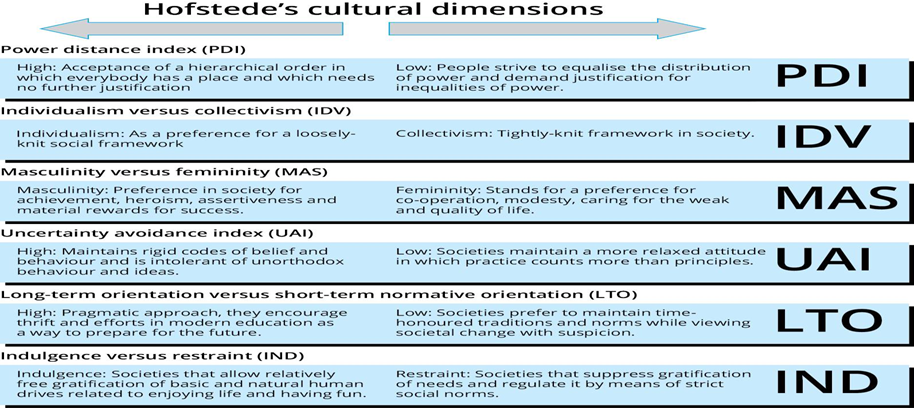
Figure 3.4 Hofstede’s cultural dimensions (Source: Geert Hofstede, Gert Jan Hofstede, Michael Minkov, “Cultures and Organizations, Software of the Mind”, Third Revised Edition, McGrawHill 2010, ISBN 0-07-166418-1. ©Geert Hofstede B.V. quoted with permission.)
3.3 Negotiation issues in international sourcing
❏ Where cultural differences have no impact on the negotiation, other factors may play a role in the overall sourcing decision when dealing with international companies
o Trust and payment issues
o Currency risk issues
o Legal and contracting issues
o Communication and logistics issues
o Ethical and environmental issues
o Political issues
3.3 Emotional Intelligence (EI)

❏ Emotional intelligence refers to the ability to perceive, understand, and manage one’s own emotions and relationships. ● It involves being aware of emotions in oneself and others and using this awareness to guide thinking and behavior.
● Emotionally intelligent individuals can motivate themselves, read social cues, and build strong relationships ● EI is a vital technique that can be used to influence the outcomes of a negotiation
• Intelligence Quotient (IQ)
• Emotional Quotient (EQ) seeks to measure

o Identifying emotions
o Evaluating how others feel
o Controlling one’s own emotions
o Perceiving how others feel
o Using emotions to facilitate social communication
o Relating to others
• Emotional intelligence
o JCA Global model of emotional intelligence
● Personal intelligence
● Interpersonal intelligence
o Use of emotional intelligence in negotiation

3.4 Assessing the process and outcomes of negotiations to inform future practice
• In negotiation there will be situations where the negotiation objective is not met
• There is still a benefit in reflecting on the negotiation and considering valuable lessons learned
3.4 Reflecting on performance
• What do we mean by reflection?
o Taking time to review what went well and what could have gone better after a negotiation session
o Key to improving the negotiation capabilities of individuals and teams in the future
• Benefits of reflection
• Areas to consider
o Process
o People
o Objectives
3.4 Reflecting on the negotiation
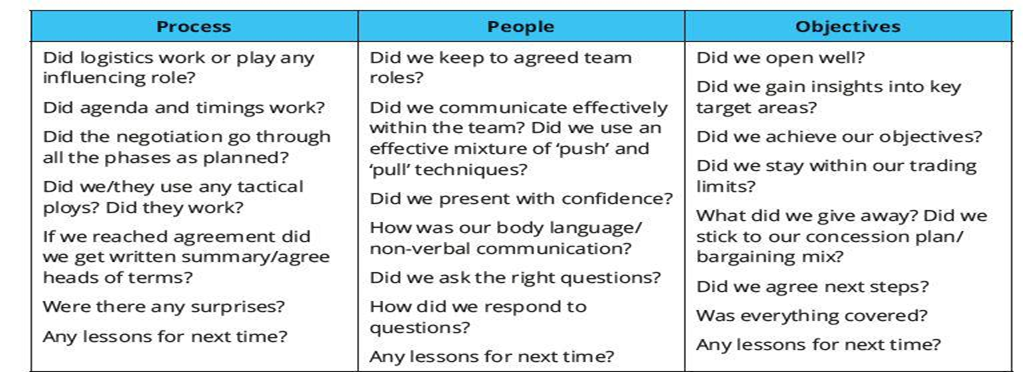
Table 3.6 Example reflection questions
3.4 Protecting relationships after the negotiation
• Consider how hard to push a supplier if goodwill trust is important in the subsequent relationship
• Tips to protect relationships
o Adopt a principled approach
o Accept that it is ok to disagree and express wishes
o Leave open the option of future business if no deal
o Respect confidentiality
o Do not lie
o Do not publicly criticise suppliers, even if negotiations break down
o Do not personalise criticism or insult individuals