c. C++ Programming
C++ programming is an object-oriented programming language which gives a clear structure to programs and allows code to be reused, lowering development costs. Applications of C++ Programming include low-level system programming to high-performance applications like game development and web browsers.
No specific pre-requisite knowledge is demanded. The course can be taken exclusively by e-learning or by blended e-learning/site based training.
Certifications:
- CPE- C++ Certified Entry Level Programmer
- CPA- C++ Certified Associate Programmer
Training Duration: Onsite; 6 months. E-Learning access: 9 months
d. Python Programming
Python programming is a general-purpose language, not specialized for specific problems, which means it can be used for various applications.
It uses a versatile language to create software, websites, automate tasks, and analyze data. Skills you will learn include; core Python proficiency, understanding of data structures and algorithms, proficiency with libraries like NumPy and Pandas, knowledge of frameworks like Django or Flask, and strong analytical and debugging skills. Applications of Python Programming include web development, data science, machine learning, software development, and more.
Certifications:
- PCEP: Certified Entry Level Python Programmer.
- PCAP: Certified Associate in Python Programming
Training Duration: Onsite; 6 months. E-Learning access: 9 months
C. CIMA (The CHARTERED INSTITUTE OF MANAGEMENT ACCOUNTANTS)
CIMA is the world’s largest professional body for Management Accountants, due to its focus on practical skills and global recognition in the field of management accounting. CIMA Courses equip individuals with the knowledge and abilities to drive business success and influence strategic decisions as its curriculum is designed to prepare individuals for a range of managerial and leadership roles, making it a valuable asset for career advancement. Like other renowned professional bodies, CIMA also provides opportunities for continuous learning and career growth.
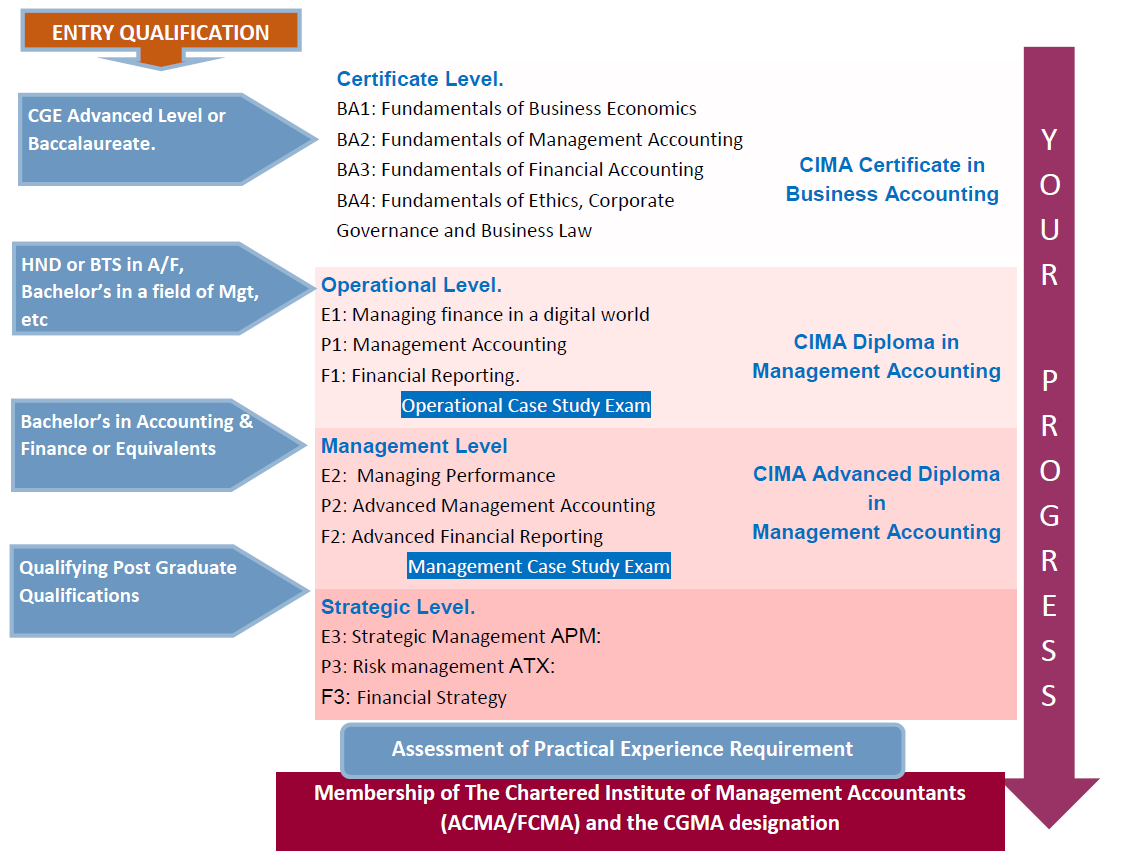
The curriculum of CIMA is highly inclusive, enabling people with different levels of education and different educational backgrounds to engage. People without a University degree have the opportunity to start at the Certificate level and progress to qualify as a Global Certified Management Accountant (CGMA) and member of CIMA (ACMA). The curriculum enables students to obtain intermediate Certificates and Diplomas as they progress to the CGMA designation.
The Institute of Management and Information Technology (IMIT) has partnered with a United Kingdom (UK) award winning tuition provider to offer up-to-date e-learning resources to CIMA students in Cameroon and the Central African sub-region, in addition to onsite training. Distant and time-constraint students can comfortably prepare for their CIMA exams by E-learning, using the online resources.
Our training resources include: A COMPLETE E-LEARNING PACKAGE comprising:
Self-paced E-learning access 24Hrs/24, 7 Days/7, comprising;
- Video lectures
- Up-to-date tutor notes
- Evaluation checkpoints and tutor debriefs
- Question bank and answers
- Mock exams and tutor debriefs and the Revision package.
On-site tutor support if needed and if possible for the student.
See the entry points for various qualifications, the study modules, and intermediate qualifications below.